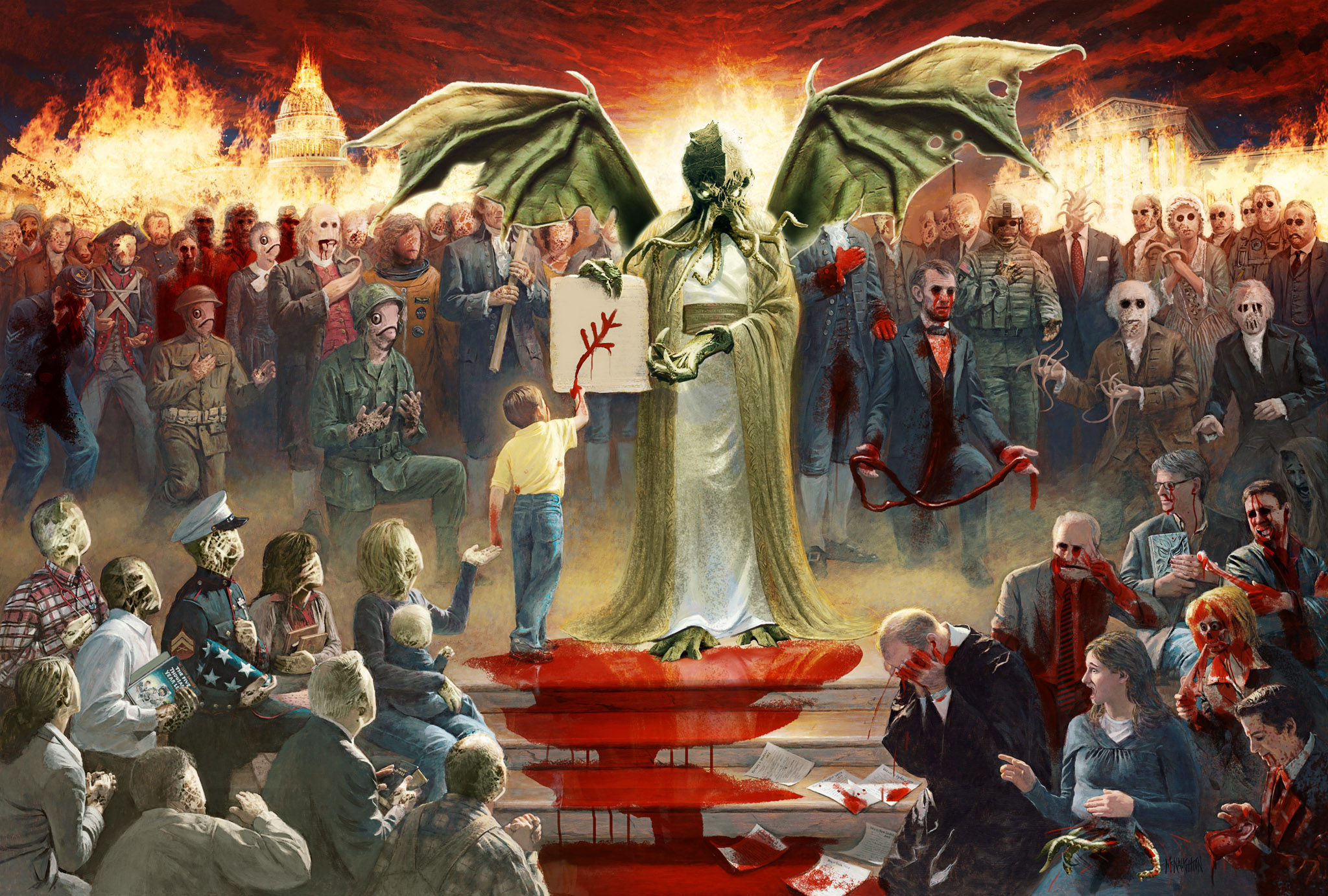
Have any of you seen this monstrosity? Yeah, now they're selling it in the BYU bookstore. [Dry heaves.]*
But it's okay, because somebody made it better.
And then somebody perfected it!
–––––––––––––––––––
*Be careful, every time somebody looks at that painting with any reaction other than revulsion, an angel is infected with syphilis.
Monday, June 21, 2010


Friday, June 18, 2010
Fat and Happy
Just got back from Seth's celestial birthday dinner:
Braised beef shortrib on polenta with pan jus and horseradish cream
Fingerling potatoes with chimichuri and lime mayonnaise
Pizza with roasted leeks, mushrooms, and corn (sounds weird, but was wonderful)
Pizza with speck (ham cured and flavored with juniper), sopprassata, garlic, tomato, and hand-pulled mozzarella
Rooibos tea
Amazing food, enjoyed with some of my favorite people in the world. Now it's naptime.
Braised beef shortrib on polenta with pan jus and horseradish cream
Fingerling potatoes with chimichuri and lime mayonnaise
Pizza with roasted leeks, mushrooms, and corn (sounds weird, but was wonderful)
Pizza with speck (ham cured and flavored with juniper), sopprassata, garlic, tomato, and hand-pulled mozzarella
Rooibos tea
Amazing food, enjoyed with some of my favorite people in the world. Now it's naptime.
Thursday, June 10, 2010
Saturday, May 29, 2010
Trinity Sunday?
 In the broader Christian world (at least those brands of Christianity with the decency to have a liturgical year) tomorrow (well, starting this evening, really) is Trinity Sunday. This focus on the members of the Godhead makes sense liturgically: Easter––Ascension (Jesus), Pentecost (Holy Ghost), and now a feast about all three of Them (or all One of Them, depending on how you look at it.);-)
Saying, "all three of Them," probably set my own patron saint revolving in his grave; he hated a certain heresy so much, he took the opportunity at the Council of Nicea to smack Arius in the face. And that brings us very neatly back to the point, as the Arian heresy tends to form a part of many LDS folks' concept of deity. (It's the notion that the Son is somehow less divine than the Father––a part of the McConkie school of thought; note that this is different than saying the Son subjects Himself to the will of the Father, which is Biblical.)
We Mormons tend to over-emphasize the distinctions between the various members of the Godhead. In fact, we often use the term "separate," which is not helpful in clarifying our beliefs for those of other faiths. (This is part of a larger problem of defining various shared theological words differently than most Christians, and then––even among ourselves––not using those words with much precision or consistence. For example, consider the word "spirit," which we use to refer to the third member of the Godhead, the Light of Christ [itself a problematic term], the general atmosphere ["a special spirit," or "you've brought a wonderful spirit to this meeting," are common uses], or the individual non-[or, for Mormons, less-]material immortal part of every person. Sheesh.)
It's understandable that we should want to be clear about our uniquely-Mormon beliefs, but frequently we swing the pendulum too far, resulting in an equal (but opposite) doctrinal confusion. After all, the Book of Mormon takes pains to emphasize that the Father, the Son, and the Holy Spirit are "One God."
Similarly, most of our dismissals of the Trinity are really straw men. So we argue against a "doctrine" that orthodox Christians do not actually profess. (To be fair, I have spoken with many protestant Christians who, while trying to define the Trinity, actually teach modalism––also called the Sabellian heresy.)
Given the extremely broad spectrum of belief possible under the Mormon umbrella, you'd be surprised how closely we can approach the doctrines accepted by our brothers and sisters who dwell in different theological terrain. You may find this article by Blake Ostler pretty eye-opening!
Finally, when we consider our doctrinal differences, we may be straining at theoretical gnats, but swallowing our own behavioral camels. We should take counsel from (and comfort in) two relevant quotes:
What soul ever perished for believing that God the Father really has a beard?
––C.S. Lewis
I never hear of a man being damned for believing too much.
––Joseph Smith
Friday, May 21, 2010


Sunday, April 04, 2010
As the sun sets...
...on the first day of this Easter season, I offer two pieces, both choral adaptations of originally instrumental works set to texts of the Requiem.
(Adapted from Barber's stunning "Adagio for Strings," it's probably too long––and too difficult––to be practical in an actual liturgy, which is a crying shame.)
Text:
Agnus Dei, qui tollis pecatta mundi
dona eis requiem.
Agnus Dei, qui tollis peccata mundi,
dona eis requiem sempitername.
O Lamb of God, that takest away the sins of the world,
Grant them rest.
O Lamb of God, that takest away the sins of the world,
Grant them eternal rest.
Lux Aeterna
(Adapted from "Nimrod," of Elgar's "Enigma Variations"––I've sung this one, and it's far more challenging than it sounds actually! Ignore the silly slide-show that accompanies it.)
Text:
Lux aeterna luceat eis, Domine,
cum sanctis tuis in aeternum,
quia pius es.
Requiem aeternam dona eis Domine,
et lux perpetua luceat eis,
quia pius es.
Let everlasting light shine upon them, Lord,
with Thy saints for ever,
for Thou art merciful.
Grant them eternal rest, Lord,
and let perpetual light shine upon them,
for Thou art merciful.
Easter
One of my Easter traditions is to re-read the following essay by Eugene England. It never fails to move me. I hope you enjoy it.

It might have been 1986, because Easter came in March and I was on my way to Montreal. But I went to see Dustin Hoffman in The Death of a Salesman (bought a ticket at the last minute from a scalper), so it must have been two years earlier on my way to Boston. When I left the theater Wednesday afternoon, I walked east along Forty-second toward the small circulating library on Forty-first and Fifth Avenue, where I was to wait for Greg Reece, a young friend who had lived with us for awhile and now worked in New York. I grinned as I watched the confidence games being played by sidewalk hustlers––giant showy posters and pirated tapes for sale, and shell games of various kinds, especially the one using three cards on a cardboard tray held by a strap around the neck. I knew the games were basic small cons that worked on tourist gullibility and greed, and I went by without even stopping. But then I decided to get a snack, jaywalked to the Burger King for some french fries, and came out right onto a game in progress.
There were three black locals and the obvious mark––a white, thin-faced tourist. I watched, munching and smiling to myself, as the dealer placed three different cards on his tray, one the ten of clubs, then turned them over and shuffled them. The three others could place twenty dollars or more on the tray, then guess which card was the ten and turn it over. If they were right, the dealer matched what they had put down; if not, he took it. The other two locals––one an older man, with a startling band of pure white hair frizzed out between his black beret and his neck, and the other, perhaps twenty, in royal blue stretch pants––won occasionally, but the tourist kept missing, even though it seemed to me quite easy to follow the movement of the cards. In fact, every time he missed and wiped his hand nervously on his red tie I congratulated myself that I had guessed right.
As I became engrossed, the dealer began to ask me after each miss if I knew where the ten was, and I said "Sure" and pointed to it––correct every time. Slowly the bets got larger and the dealer, keeping up a constant patter about how easy it was ("See how often these guys win?"), began to chide the tourist for his misses ("See how this guy," pointing to me, "does it."). Finally, after the tourist missed on a sixty dollar bet, the dealer asked me to point out the ten without turning it over. "Just look under a corner and see if you're right." I said I was, and he said, "Show this guy. Put down sixty dollars, turn over the card again, and you can win." I refused ("That wouldn't be fair to you," I said), so he had Black Beret do it and win sixty dollars. They all made fun of me, and some others now gathering around did, too.
I felt my heart going, pulsing in my head as the game continued, and then the same sequence developed again: a miss by Red Tie, constant patter, invitation to look (right again), then insistence by all that I turn up the card again and take the sure winner. I thought of the ticket I'd bought for Death of a Salesman, four times what I had ever paid for a play before, and I thought about other plays I wanted to see. I took out my wallet, looked down to count––$149 for all the rest of the trip––and watched myself put out the sixty dollars and turn over the card. Three of diamonds.
I was dazed. The game went on without a hitch––mostly wins by Black Beret and Stretch Pants, losses by Red Tie. The pace accelerated and the crowd was growing and talking, some commiserating with me. I tried to pull away. The patter motored on, and I knew the panic of loss, of betrayal, of desire. I wanted everything to stop. I wanted bitterly not to have lost, to be back at Burger King before all this, to have watched the cards more carefully. But I could still see, as a great calm in the frenzy of talk and shuffling, the cards––and how right I was each time. The patter focused more on me. "Turn it over. See, you're right. Put your money on it. I owe you one, I'll make it up to you, this time three for one." Black Beret was helpful, like a kind uncle: "Do it," he whispered. "He wants you to win it back––it'll get the crowd with him." The dealer's eyes were enlarged, protruding, the mouth constant. I looked into my wallet and––with a lurch––put sixty dollars down and turned the card over. Six of hearts.
"No, look, it's this one," said Black Beret, sympathetically, turning over the ten. The crowd jammed in and swelled its noise. "That isn't fair, you promised him." "Mind your business," snarled the dealer––then, with a quick glance toward Fifth Avenue, "Oh, oh, cops coming." The crowd left, and the dealer, Black Beret, Stretch Pants, and Red Tie walked quickly together toward Broadway, leaving me frozen, spent, swirling in a tempest, damned, gaping, clear only about one thing––I was the mark, the only mark.
As I stood there and then walked east I was absolutely serene and absolutely violated: calm, unsurprised to see no police descending on the illegal game, intensely aware of people, food carts, lights, dimming sky––but cordoned off, invisible. I walked down Fifth Avenue to the library and went up to the reading room and got out my paper for the Shakespeare meetings to go over until Greg came, but I could not see the words.
I watched a lady across the table in a print dress and imitation fur-collared coat that she kept partly buttoned. She had notebooks and folders full of bills and receipts and lists and slips that she kept shuffling and restacking and poring over and making new lists from. At first I thought she was balancing her checkbook, but she kept going over the same things, shifting in her chair, restacking the lists, sighing, copying new figures, pursing her lips, returning to the notebooks and then the slips of paper, erasing, writing, always intent. I couldn't tell what she was doing. I had to stop watching.
Greg and I walked back along Forty-second, past Burger King to Broadway, where we went underground and caught the B train local up to Seventy-ninth. Greg could see something was wrong but didn't pry, just stopped suddenly––twice––to look at me as we talked, once putting his hand on my shoulder. We got off and walked back to Seventh-sixth, where he had booked tickets for Sam Shepard's A Lie of the Mind at the Promenade. (But that was 1986, wasn't it?) "I'm a little short on cash. Can I send you a check?" I asked, and he said sure and didn't object when I suggested that, instead of going to dinner before the play, we walk down to Lincoln Center and see the Chagall windows in Avery Fisher Hall and grab a soft pretzel with mustard on the way ("My favorite tourist indulgence," I said with just the right touch of self-mockery). My mind had come unfrozen enough to begin to calculate how I could make it home on my remaining twenty-nine dollars cash without getting any more money or admitting my plight––and in a way that would make me suffer (that seemed very important): One dollar for the subway, one for the pretzel, another dollar fare to Greg's apartment in Brooklyn after the play.
But what about getting to the airport? As we walked, Greg filled me in on his job with a new TV production company, but he could tell I was preoccupied. "How can I get to LaGuardia from your place by 7:30 in the morning?" I suddenly asked. (That must have been 1984). He stopped and looked at me, then went on. "Well, you can sleep in, have one of my great breakfasts, and take a taxi right up there, maybe twenty minutes," he said. "Or you can get up at 5:00, leave me asleep, grab a piece of toast, and take the subway back in here and then out to the airport––give yourself two hours." After a moment, seeing I was serious, he added, "The taxi is twenty dollars, the subway plus the bus from the nearest stop is two."
Back at the theater, Greg told me we were in the old Manhattan Ward meetinghouse. He pointed to the unusual arched doorways and alcoves and blocked-in windows as we went through the foyer and up the stairs into the main theater. When my eyes adjusted I could see the huge encompassing arches on four sides that had framed the original chapel and supported the dome above. The space was now filled on three sides with banks of seats, with a wide stage on the fourth side and a catwalk above. In the program I read, "First constructed in 1928 as a Mormon Church, the building was refurbished and officially opened as the Promenade Theatre in 1969. ... New York's only Off-Broadway theatre on Broadway."
Shepard's play, one of his earliest, is a preparation for the more well-known Fool for Love; both plays chart the agony of Western misfits, grotesque and universal in their irrational revenges and bizarre, literally or spiritually incestuous, loves. Greg doesn't like Shepard's work and had gotten the tickets after my phone call only out of kindness, but I find Shepard the most attractive as well as troubling new American dramatist. He is willing to use the bleak lives and dry landscapes and tacky motels and vicious words that are one part of a section of America usually neglected in drama, the twentieth century West I grew up in. And he does not merely imitate those lives but invests them believably with the great human themes of love and death and with passages of poetry and even occasional, quite "unrealistic" but believable epiphanies. For instance, at the end of this play, Jake, who has nearly killed and then deserted his wife in one of his recurrent fits of jealousy, returns to tell her that her reality, the truth of her generous, ingenuous being that has so infuriated him, is also what makes all other ideas and presences unreal, merely a lie of his mind. In an act of amazing mercy that her unique reality has taught him and finally made possible for him to do, he gives his life to preserve her––and in doing so finally changes himself.
It hurts very much to think of you. How could you suffer not only our pains but our sicknesses and infirmities? Did you actually become sick and infirm or merely feel, with your greater imagination, something like what we feel when we are sick and infirm? But could you actually "know according to the flesh," as you say, if you didn't literally experience everything with your body? And if you did literally experience our infirmities, did you know our greatest one, sin? Everyone says you didn't sin, that you were always perfect. But how then could you learn how to help us? And yet if you did sin, if you actually became sick and infirm and unwilling, for a moment, to do what you knew was right, how does that help us? I don't want you to hurt like this, like I do now, to be ashamed, to hate the detailed, quotidian past. Yet I want you to know the worst of me, the worst of me possible, and still love me, still accept me––like a lovely, terrible drill, tearing me all the way down inside the root, until all the decay and then all the pulp and nerve and all the pain are gone.
Can't you tell us directly, without all the mystery and contradiction, if what I feel is right? Could it be that your very willingness to know the actual pain and confusion and despair of sin, to join with us fully, is what saves us? It's true, I feel your condescension in that; I feel you coming down from your formidable, separate height as my Judge and Conscience. I feel you next to me as my friend. Did it happen in Gethsemane, when you turned away from your father and your mission for just a moment? I think so. So how can I refuse to accept myself, refuse to be whole again, if you, though my Judge whom I hide from, know exactly what I feel and still accept me? Yet it hurts so much to hear you tell of your pain to Joseph Smith, when you remember that moment in the Garden. You say, "Which suffering caused myself, even God, the greatest of all, to tremble because of pain, and to bleed at every pore, and to suffer both body and spirit––and would that I might not drink the bitter cup, and shrink––Nevertheless, glory be to the Father, and I partook and finished my preparations unto the children of men."
Was that preparation so painful, even when you recalled it as the resurrected Lord––and so many hundred years later––that you still shrank and could not complete your sentence? Is that pause between "shrink" and "nevertheless" the actual moment of your Atonement? And why did you also tell Joseph that you will be red in your apparel when you come, in garments like one that treadeth in the winevat? Why will you have to say then, "I have trodden the winepress alone, and have brought judgment upon all people; and none were with me."
Who is it can withstand your love?
It cost me five dollars from Dorval Airport to the Ritz-Carlton Hotel in Montreal, but I had paid for the room in advance and could fast for a few days. The other participants in my seminar Thursday afternoon seemed to like my paper on "Shakespeare as a Healer," though they were more interested in his possible knowledge and use of Renaissance psychological therapy than in my evidence for his preoccupation with Christian ideas about healing the soul. It was just as well. I was feeling very much a hypocrite, a talker, an absurd posturer who knew to do good and did it not. What did I really know about healing?
The next day I slipped out between sessions to visit the Montreal Fine Arts Museum, just up Rue Sherbrooke from the hotel, but found it closed. It was Good Friday in heavily Catholic French Canada. Walking back I heard singing from a small stone Protestant church. A constantly smiling, bustling, very delicate black woman found me a seat and gave me a program and hymnal (I watched her a moment, noticing her color and her soft, scurrying solicitude; New York had seemed all black, the Shakespeare Association meetings lily-white). The choir finished singing a Monteverdi motet, and a lay reader, a tall blonde woman with a black surplice hanging loosely over her bright orange dress, gave the Old Testament lesson from Isaiah 53, the "suffering servant" passage: "He is despised and rejected of men; a man of sorrows, and acquainted with grief: and we hid as it were our faces from him. ... by his knowledge shall my righteous servant justify many; for he shall bear their iniquities. ... he hath poured out his soul unto death: and he was numbered with the transgressors." Then we sang Bach's Chorale from the St. Matthew Passion:
O sacred head, sore wounded,
With grief and shame weighed down,
Now scornfully surrounded
With thorns, Thine only crown. ...
What Thou, my Lord, has suffered
Was all for sinners' gain:
Mine, mine was the transgression,
But thine the deadly pain.
Back at the hotel I asked about other Good Friday observances. Were any scheduled at Notre-Dame, the large cathedral-like church I had seen while walking through the Old City by the St. Lawrence River the night before? The concierge was uncertain but thought there would be something at 3:00 p.m., the traditional hour of Christ's death. He confirmed by calling the church for me. Since I had to walk, I left right after the general session that ended at 2:00 and hurried east along Rue Sherbrooke to Rue Université and then south to Notre-Dame, which in daylight seemed built somewhat like the two-towered Notre Dame Cathedral in Paris. Only two blocks away I found police cars setting up barriers for a crowd of several thousand people just coming along Rue Ste. Catherine from the east and turning down Rue Université to the church. I joined them and found an English-speaking participant who explained they had made a twelve-mile march beginning that morning, an annual pilgrimage complete with "stations of the cross" as the stopping places. A truck with large loudspeakers was leading, and a man in the front seat continuously sang religious songs for the marchers. They were of all ages and dress: priests, nuns, groups of children, solitary housewives, blue-collar men, young couples, many with wooden crosses hung around their necks, some in groups carrying full-size crosses, a few with banners: "Vendredi Saint," "Jesus, Notre Sauveur," etc. They were welcomed at the Cathedral by a brass band and a large crowd; then all of us pushed in to fill the huge main floor and the two galleries.
As we waited I walked the full circuit of aisles, trying to respond, as I had in the cathedrals in Europe, to the builders' sense of space and light. The stained glass in this church is too realistic and sentimental for my taste, but the sanctuary, with its high altar, is gorgeous: rich in light, simply proportioned but with much sculpture, which is focused in a huge figure of the risen Christ, seated in glory above a figure of the crucified Christ. The artworks and small chapels on the perimeters are ordinary, except for a striking painting of an early French nun earnestly teaching Indian children, the children's faces angled in what seems accusing innocence toward the viewer. I thought of Tucker-man's chilling line, "They have their tears, nor turn to us their eyes."
A white-robed priest began to address the congregation about 2:30 and continued for twenty minutes. My French was only good enough to get the general drift: an informal homily on the sins of the day. I moved up the left outside aisle and slipped into a marble corner at the side of the stairs from the nave up to the sanctuary, where I could watch both the priest and the audience. He was obviously very popular, occasionally joking, using the device––which seemed to work well––of repeating a rhetorical question, "And have we sinned?" followed by an example or two and then the question again. Occasionally his exhortations led him to mention a hymn, which he would then start singing, and the congregation would join in. Finally an usher spotted me and sent me to find a seat; but by this time there weren't any, so I stood at the back. The priest, now far away from me, mentioned Mary and then began singing "Ave Maria." I heard a trumpet behind me softly join in and turned to see a black teenager, who reminded me of Stretch Pants, slowly move forward through the main doorway, playing the melody. Then, as the singing ended, he continued playing solo, slowly moving back. His mother was standing in an alcove, watching, and after he finished, she moved to stand by him, her hand on his arm.
At 2:50 the priest quickly finished his talk and a complete silence fell over the congregation until 2:55, when a group of priests, white-robed and hooded, evidently representing all of us, filed up to the altar and gazed up at the crucified Savior until 3 :00. The signal of the moment of death was a sudden lighting of the brightest altar lights; all the congregation stood and remained in silence for a few minutes. Then slowly we left.
In the mid-seventies I sometimes went fishing at North Eden. That tiny delta and valley, opening into the east side of Bear Lake in northern Utah, was homesteaded, along with a similar, smaller valley, South Eden, late in the nineteenth century. Two small reservoirs were built in North Eden to hold water through the summer for irrigating hayfields and perhaps a few gardens. Someone planted the reservoirs with rainbow and brook trout, which grew, as did the native cutthroat, into huge fish in those isolated, food-rich lakes: the cutthroats lean, fierce fighters; the rainbows and brookies jeweled and heavy-sided. One of my father's complicated business transactions had left him with a partial interest in the one remaining ranch and a key to the gate at the valley's west end that kept most people away from the reservoirs.
On a mid-August morning before sunup, one of Dad's clients, who insisted on taking his Jeep Wagoneer, drove us east from Salt Lake City to Evanston and then north along the Utah-Wyoming border through Woodruff and Randolph, down the long incline to Laketown on the south shore of Bear Lake, then up the east side.
I was alone in the back seat, only half-listening to my father's usual cheery commentary and storytelling. My own thoughts were dull, almost despondent: I had been released from St. Olaf College the year before in what looked to me (and some colleagues) like a decision to eliminate my influence on students, one of whom had joined the Mormon Church. Then I had been turned down for a position at BYU, apparently because of concern about what parents might think about how a person of my unorthodox views and background might influence students. At the same time, I was turned down at the University of Utah, because, as one of my former teachers there confided with regret, "This department simply won't hire an active, believing Mormon." (Which was I, too devoted a Mormon––or not devoted enough? Where was my home, my vocation? In Zion or in exile?)
We had moved to Utah and were subsisting on part-time institute teaching for the Church in Ogden and Salt Lake and a writing fellowship in Leonard Arlington's Church History Division––and a large garden at our home in Kaysville. And I had begun to lose confidence. Perhaps I didn't have a job simply because I wasn't good enough, didn't have enough scholarship published or good enough teaching evaluations to overcome those other qualms administrators were having (after all, I hadn't been accepted at the other places to which I had applied either). I had felt the mantle leave me when I was released as branch president in Minnesota, and no spiritual security had replaced it. I found it hard to pray, to remember what it had felt like to bless my branch members and family with complete assurance and to know with certainty the Spirit's response. I wondered constantly, in blank repetition through broken sleep as we drove, if I had lost my way, if the Lord knew there was such a person anymore. I wondered where the deepest part of me had gone.
We had our boat in the higher lake by 7:00 a.m. and headed for the upper end, where the fishing just out from the stream mouth had been best in late summer. I sat in the prow facing the early sun and the sharp canyon wind, smelling the water and observing the long scar the mule-pulled Fresno scrapers had made long ago as they brought down fill for the dam. Suddenly I saw to my right a V in the water, much like our boat's wake but very small, moving rapidly across to the shore on our left. I silently pointed and Dad slowed so that we intercepted the double riffle, just behind a four-foot rattlesnake, moving with the same motion it makes on open sand, its yellow on black diamonds and beige rattles and thick body clearly visible under our prow. None of us spoke.
Using wet flies cast with a bubble, we each took our limit of three trout over five pounds and, acknowledging the mutual agreement of those fishing on this private lake, put the many others we caught back. Two that my father caught with his own self-designed version of a double woolly worm that ended in a red tuft must have weighed over eight pounds.
We tried some dry fly casting in the early afternoon, and I watched a huge brookie rise to take my dragonfly and then, coming in, suddenly turn uncontrollably under the anchor rope and snap the delicate leader, close enough that I could see the rich scattering of blue and red-gold aureoles down its side. I felt it go, with no regret. By 4:00 the wind up the canyon off Bear Lake was too strong for good fishing, and we left. Dad and I both offered to drive, but the client, who had taken a nap, insisted he wasn't tired and for variety headed around the lake to Garden City and down Logan Canyon, with me sleeping across the back seat and Dad dozing in the front.
When I came up out of unconsciousness I had my hands on my father's head and could feel his hair and blood. I couldn't hear the words I was saying, but I felt them from the blessing part of me, the deepest part, before consciousness. Dad was more conscious than I was but more hurt. I gradually began to see the ground, the fir trees, then the cars just down from us. There was a blue Austin impaled at a slight angle onto the front of the Jeep. All of the Jeep's doors were sprung open, and the freezer of huge fish was splashed across the highway. I kept my hands on Dad's head and began to hear his moaning, then felt pain emerging in my own chest and struggled to breathe.
Police came over soon and told me our driver had fallen asleep and run head-on into the Austin, which had been driven by a German tourist whose legs had been broken. Ambulances were on the way. Each new face asked me where we caught the fish. Our driver, who wasn't hurt at all, kept apologizing, frantically. He knew my father was dying. When the ambulances came, they put Dad in the first one and tried to get me to lie down by him, but that made it even harder for me to breathe. At the Logan hospital they made me lie down for x-rays of my broken ribs, and I nearly fainted. Then the technician told me they had seen what looked like a bruise on the upper aorta in my father's x-rays and were going to rush him to Salt Lake because the artery could burst at any moment.
I asked the technician if he would help me give my father a blessing, and he nodded and went for some consecrated oil. We found Dad on a gurney in the next room, barely conscious, the whole left side of his face, where he had struck the dashboard, going purple. I blessed him with life, specifically with the five years he had told me that spring he needed in order to complete the arrangements to consolidate our family investments and transfer them into the Church's missionary funds. The words were given to my tongue, beyond my mind. I called Charlotte and Mom and told them we'd had a slight accident, to call Dad's friend, heart surgeon Russell Nelson, and to meet us at the LDS Hospital.
But all confidence left me on the ninety-minute, blaring-sirens ambulance ride to Salt Lake. I sat in the front seat, Dad and a doctor and nurse just behind me through a curtain. As the driver radioed ahead, asking Dr. Nelson to be ready and describing the emergency, I was constantly sure someone would soon push through the curtain to tell me the aorta had burst and my father was dead. When we arrived, Dad was rushed into surgery and Charlotte stayed with me while I got us checked in and walked to my own room. Then I couldn't breathe again. Charlotte got them to look at my x-rays, which I was carrying; they decided that my collapsed lung needed immediate attention and sent Charlotte out while an intern gave me a local, made an incision, and pushed a hollow needle between my ribs and began to evacuate the chest cavity so my lung would reinflate.
Charlotte came back to tell me my father was fine––except for some missing teeth and a broken jaw. The new x-rays they took for Dr. Nelson showed no bruise on the aorta. I thought of the fish, the brookie, and the part of me that moved to heal my father before I knew anything. We were alive.
I made it back to Manhattan (another seven dollars, leaving me twelve dollars) in time to meet Greg for the matinee of Hamlet at the Joseph Papp Shakespeare Festival Theater near Astor Place. "Put both these tickets on the tab for that check I'm sending you," I said when he came up. "I owe you for the toast." I was anxious to see what Liviu Ciulei, the great Hungarian director who is now in charge of the Guthrie Theater in Minneapolis, would do with this difficult and (in my opinion) usually butchered play and to see the popular movie actor, Kevin Kline, do the lead. (This was certainly 1986.) I was disappointed in both of them: more of the same traditional misreading of the play as simply a struggle by a romantic intellectual to get enough courage to take bloody revenge on the uncle who killed his father.
Ciulei's best decision was to let the costuming and instincts of the actors follow Shakespeare's words and show Hamlet becoming more and more like his monstrous uncle as he succumbs to the revenge spirit. The poison that symbolizes that spirit is initially dropped by the uncle into Hamlet's father's ear, then, in the call to revenge, is dropped into Hamlet's ear by the father's ghost and, in direct response to Hamlet's threats, into Laertes' ear by Claudius. By the play's end that poison is spreading to corrupt and finally kill them all. Ciulei also allowed Harriet Harris to play Ophelia in a way that let the words speak true, even against the rest of his direction. She was able to show a woman and her innocent love being ground to pieces between the sinful male "honor" of Hamlet and the sinful male "protection" of her father.
After the play we walked up past Christopher Park and found, at the corner of West Fourth Street, a quartet of young men, two on violin, one on viola, and one on cello, just beginning Haydn's "Sunrise Sonata." They were about the same age as Stretch Pants and the trumpet player in Montreal but were dressed in levis and T-shirts, like the dealer. They were excellent musicians, and most of the rowdy crowd stood quietly or passed by carefully. Nearly everyone put a quarter or two into the open case, but I waited, thought, felt within me the war of blame for the con game––and guilt and racism––against all my opposing beliefs, and furtively put in five dollars. As we caught a bus up Seventh Avenue, I told Greg I thought I'd get some rest before Easter, left him at his station on Forty-second, and transferred across and up Madison to the empty apartment on Sixty-third that Dave and Karen Davidson had lent me for the weekend. I bought bread at the corner deli and explored the refrigerator––but still felt I shouldn't eat and slept uneasily.
This is my report. I have been assigned to George England, one of my descendants, for thirty years now. He carries my own name but does not use George often, though that is his first name. I have protected him well, but I do not understand him. I think I should remain on this assignment for at least one more ten-year term.
The main problem is that George understands what is right to do but does not do it. He knows more about the Atonement than I did when I was branch president in Lyme Regis––or even when I became a patriarch in Plain City after the crossing to Utah. He writes constantly about it, even when he is writing for the gentiles about literature. Many people praise him for what he says; they write letters to him telling how he helped them live the gospel better and helped them understand repentance. But he still does terrible things. It is still hard for him to be honest. He covers up his mistakes with lies. He pretends he knows things or remembers people or has read books when he has not. I think he loves to do right, but he has a hard time being honest or kind when the chance to do so is sudden or embarrassing or when he is in pain or lonely. If he has time to think, he is very often good, but not when he is surprised.
When I helped him marry Charlotte Ann, you know how much better he was for awhile. He began to learn from her to be generous before he thought about it. He even began to be honest like she is, without toting up the cost. But after all that self-pity when he lost his job at St. Olaf ten years ago he began to be a hustler, to cut corners, to take advantage. I was able to use that car accident to help him know he was good. And when you arranged for him to be a bishop, that was fine for awhile. But he seems to have lost contact with Charlotte Ann. He isn't listening to her very well, and he isn't telling her what he really feels. I think she is getting tired.
Perhaps he is writing too much. I am certain he is not praying enough. He is worried, though, and wondering, sometimes frantically, I think, why there is not someone to help him the way he has helped some who have needed him. He does not seem to be able to ask for help. Perhaps something will happen that we can use. I hope so. My heart reaches out to complete the circle. I think some good chances will come now that he is in a bishopric again and working with the primary and the Cub Scouts––and also when he becomes a grandfather in two years.
I am sorry about the language of this report. I know you want me to learn from him, but it is hard when he talks so very little. Please excuse all mistakes.
I couldn't sleep and then overslept, so I had to run all the way up through the Easter-dressed people on Fifth Avenue to make it to the Metropolitan Museum of Art on Eighty-first by the 10:30 opening. I paid one dollar of the four-dollar suggested contribution (leaving me one last bus fare plus just enough to get to the airport the next morning). I went right to the Rembrandts and Vermeers, but even there I found I could only focus well on two paintings: Rembrandt's gentle "Christ with a Pilgrim's Staff" and Vermeer's quiet, consuming "Woman with a Blue Pitcher," the young housewife working calmly in that corner of a room that Vermeer painted again and again, as if he might understand the whole world through one place seen completely. Then I hurried down the long hall, past the antique pianofortes, to the south wing––Manet's white apparition, "Woman with a Bonnet," framed in the doorway as a beacon visible all the way. But I turned quickly to find my favorite Manet at the far right: "The Dead Christ with Angels."
Critics of the nineteenth-century French Academy did not like the extreme realism, the precisely bird-like blue wings on the two angels and the heavy, black-shadowed cadaver. But I find the moment captured by Manet extremely moving. It is not the traditional moment of shining glory after life returns. It is the dark time of struggle as Christ's divine spirit is still creating the resurrection from within his still-dead mortal body, with the angels still sorrowing, holding him up, urging life to return. I agree with Emile Zola, the French novelist, who wrote of Manet's "obstinate eye and audacious hand," his ability to imagine and realize such angels, "those children with great blue wings who are so strangely elegant and gentle." These are the angels Mary Magdalene saw later, when she found the tomb empty, the two still "sitting, the one at the head, and the other at the feet, where the body of Jesus had lain" (John 20:12). At the front of the painting is a snake, the one from Eden, its head about to be crushed according to the promise.
I took the bus across Central Park to the chapel on the second floor of the Church-owned office building on Sixty-fifth and Broadway so I could make sacrament meeting at noon. After the sacrament was administered, a short Easter musical program preceded the regular testimony bearing. But if this was 1986 then it was on the last Sunday of March, rather than the first Sunday, when Mormons normally fast for twenty-four hours and bear testimony. And the printed program I saved proves that it was indeed Easter. Anyway, after the choir's "Easter Hymn" and a woman's quartet singing "The Lord's Prayer," the choir leader (Andrea Thornock, I see from the program) sang "He Was Despised" from The Messiah. She had dark hair and wore a long surplice-like overdress. It was made of what looked like velvet and was dyed a striking grape red. Her somber alto voice reminded us of the costs of salvation: "He was despised, rejected, a man of sorrows"––her voice pronounced exactly the grief in that three-note dying fall on "sorrow" that must have come from Handel's own pain. She looked straight into our eyes, as she slowly turned and looked across the congregation: "He hid not his face from shame, from shame and spitting."
Then Liz Hodgin, in a lovely floral print and pink hat, sang the soprano solo that has been called by Kenneth Clark and others the greatest piece of human music: "I Know That My Redeemer Liveth." But it is that, I believe, only when it is sung by someone, like Liz, who believes, who sings her own testimony as well as Handel's. And our hearts were lifted from the depths Andrea had properly taken us down to. I blessed Andrea for planning such a program and for being part of it, for remembering, though we Mormons don't often notice Good Friday, what that somber day is meant to recall: that Christ was suffering servant as well as glorious victor, that, like all of us sinners, he had to die before he could be resurrected.
The bishop bore his testimony, not about the resurrection but about the power of repentance, which he had experienced personally. An elegantly dressed businessman picked up the theme by confessing, in a careful, broken voice, how Christ had changed him twenty years before, suddenly, completely. A short man with a beer belly, thinning, long black hair, and a black leather jacket, almost a caricature of the aged hippie, spoke softly of his long, slow, still-backsliding conversion. And a young Puerto Rican on the bench in front of me, whom I had noticed struggling for courage to get up, spoke last. He told how a few weeks before he had made a Saturday trip to see this strange part of New York, had wandered into the LDS visitors' center on the main floor just below us, and had met some missionaries and joined the Church. He tried to describe his former sins and how he had changed. "I'm sorry in all the world," he kept saying. "I'm sorry in all the world."
Saturday, April 03, 2010
Holy Saturday

Christina Rossetti
There is nothing more that they can do
For all their rage and boast;
Caiaphas with his blaspheming crew,
Herod with his host,
Pontius Pilate in his Judgment-hall
Judging their Judge and his,
Or he who led them all and passed them all,
Arch-Judas with his kiss.
The sepulchre made sure with ponderous Stone,
Seal that same stone, O Priest;
It may be thou shalt block the holy One
From rising in the east:
Set a watch about the sepulchre
To watch on pain of death;
They must hold fast the stone if One should stir
And shake it from beneath.
God Almighty, He can break a seal
And roll away a Stone,
Can grind the proud in dust who would not kneel,
And crush the mighty one.
* * * * * * *
There is nothing more that they can do
For all their passionate care,
Those who sit in dust, the blessed few,
And weep and rend their hair:
Peter, Thomas, Mary Magdalene,
The Virgin unreproved,
Joseph, with Nicodemus, foremost men,
And John the Well-beloved,
Bring your finest linen and your spice,
Swathe the sacred Dead,
Bind with careful hands and piteous eyes
The napkin round His head;
Lay Him in the garden-rock to rest;
Rest you the Sabbath length:
The Sun that went down crimson in the west
Shall rise renewed in strength.
God Almighty shall give joy for pain,
Shall comfort him who grieves:
Lo! He with joy shall doubtless come again,
And with Him bring His sheaves.

Something strange is happening––there is a great silence on earth today, a great silence and stillness. The whole earth keeps silence because the King is asleep. The earth trembled and is still because God has fallen asleep in the flesh and he has raised up all who have slept ever since the world began. God has died in the flesh and hell trembles with fear.
He has gone to search for our first parent, as for a lost sheep. Greatly desiring to visit those who live in darkness and in the shadow of death, he has gone to free from sorrow the captives Adam and Eve. The Lord approached them bearing the Cross, the weapon that had won him the victory. At the sight of him Adam, the first man he had created, struck his breast in terror and cried out to everyone: 'My Lord be with you all.' Christ answered him: 'And with your spirit.' He took him by the hand and raised him up, saying: 'Awake, O sleeper, and rise from the dead, and Christ will give you light.'
I am your God, who for your sake have become your son. Out of love for you and your descendants I now by my own authority command all who are held in bondage to come forth, all who are in darkness to be enlightened, all who are sleeping to arise. I order you, O sleeper, to awake. I did not create you to be held a prisoner in Hell. Rise from the dead, for I am the life of the dead. Rise up, work of my hands, you who were created in my image. Rise, let us leave this place, for you are in Me and I in you; together we form one person and cannot be separated.
For your sake I, your God, became your son; I, the Lord, took the form of a slave; I, Whose home is above the heavens, descended to the earth and beneath the earth. For your sake, for the sake of man, I became like a man without help, free among the dead. For the sake of you, who left a garden, I was betrayed to the Jews in a garden, and I was crucified in a garden.
See on My Face the spittle I received in order to restore to you the life I once breathed into you. See there the marks of the blows I received in order to refashion your warped nature in my image. On My back see the marks of the scourging I endured to remove the burden of sin that weighs upon your back. See My hands, nailed firmly to a tree, for you who once ... stretched out your hand to a tree.
I slept on the cross and a sword pierced My side for you who slept in paradise and brought forth Eve from your side. ... My sleep will rouse you from your sleep in Hell. The sword that pierced Me has sheathed the sword that was turned against you.
Rise. Let us leave this place. The enemy led you out of the earthly paradise. I will not restore you to that paradise, but will enthrone you in heaven. I forbade you the tree that was only a symbol of life, but see, I who am life itself am now one with you. I appointed cherubim to guard you as slaves are guarded, but now I make them worship you as God. The throne formed by cherubim awaits you, its bearers swift and eager. The bridal chamber is adorned, the banquet is ready, the eternal dwelling places are prepared, the treasure houses of all good things lie open. The kingdom of heaven has been prepared for you from all eternity.
Friday, April 02, 2010
Good Friday

The Thirteenth Station
Emeric J. Carmody, O.Carm.
Emeric J. Carmody, O.Carm.
Glowering dusk and a figure at your knees;
The clotted Face against your burning breast.
Grief’s storm past, deeper seas
Wind-churn and boil to whiteness. At last His rest:
The ledgered sum full paid for Eden’s bail.
O mounting flame! As through His vacant eyes
The tangent riddles of your heart congeal:
Pale Gabriel. The stir of love within. Black skies
Kindled into ecstasy by the timbre in His cry.
Old Simeon. His Father’s house. That dark “not yet.”
And then, that sword-thrust dawn, He waved good bye
Through purple mists. John’s hand. The sun has set.
Cloth and aloes waiting. Enough. Heat-white,
Your heart shall sing Magnificat throughout the night.
Very special thanks are due to Fr Peter, for sharing the gorgeous sonnet above––the first time, a few years ago, and then again this year. You know it's good when we are forced to turn to Bach to find music to pair with it! Today's music is, of course, the beginning to the immortal Matthäus-Passion, a monumental piece so glorious as to beggar all description. It is required listening for Good Friday. Leonard Bernstein called it "a revered masterpiece––perhaps one of the divine dozen in all musical literature ... a work of such dramatic power and invention, as seldom, if ever, been equaled." I am inclined to agree with that assessment.
Thursday, April 01, 2010
Maundy Thursday
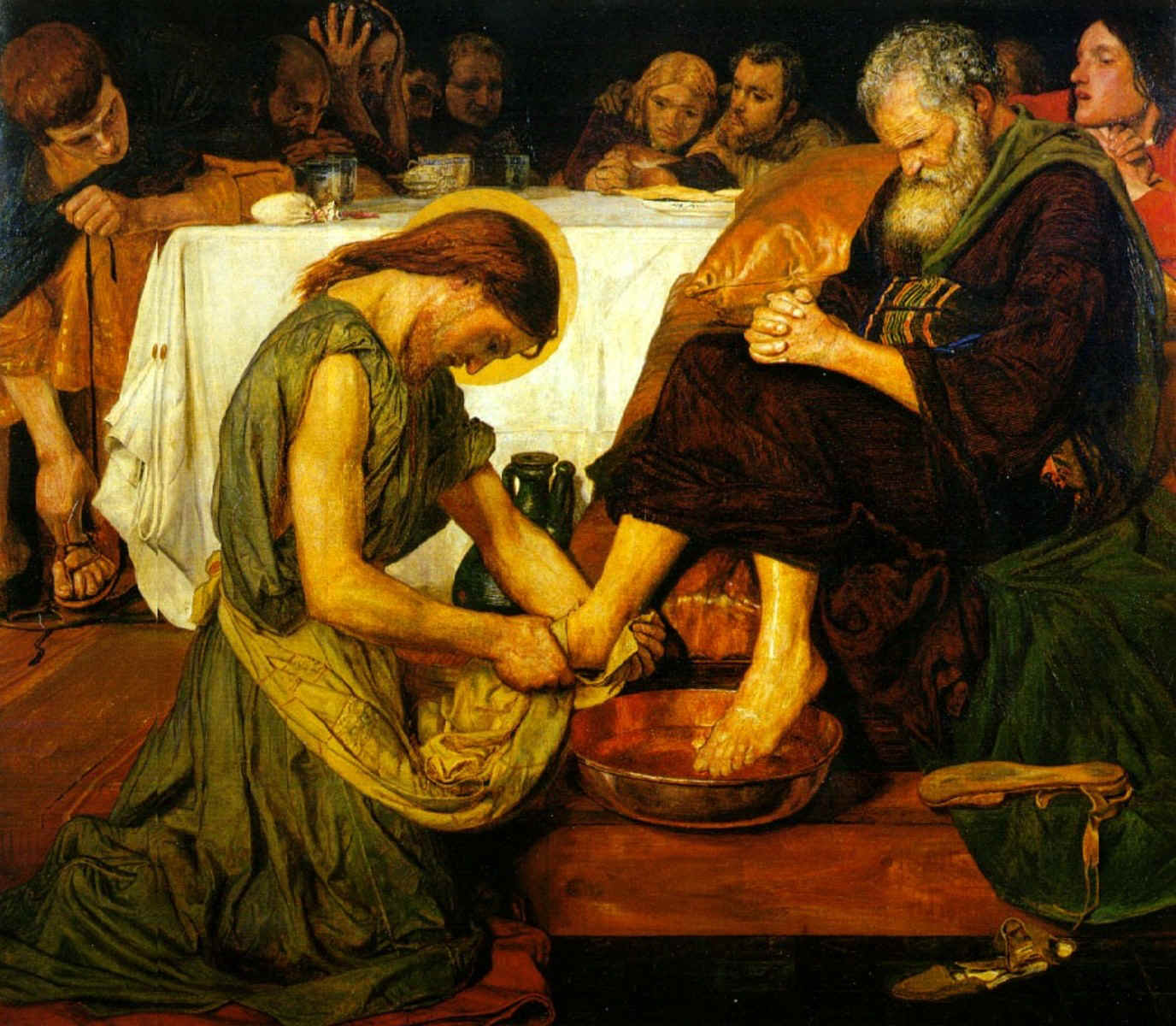 “And the Vine said . . . Should I leave my wine, which cheereth God and man, and go to be promoted over the trees?”
The great Vine left its glory to reign as Forest King.
“Nay,” quoth the lofty forest trees, “we will not have this thing;
We will not have this supple one enring us with its ring.
Lo, from immemorial time our might towers shadowing:
Not we were born to curve and droop, not we to climb and cling:
We buffet back the buffeting wind, tough to its buffeting:
We screen great beasts, the wild fowl build in our heads and sing,
Every bird of every feather from off our tops takes wing:
I a king, and thou a king, and what king shall be our king?”
Nevertheless the great Vine stooped to be the Forest King,
While the forest swayed and murmured like seas that are tempesting:
Stooped and drooped with thousand tendrils in thirsty languishing;
Bowed to earth and lay on earth for earth’s replenishing;
Put off sweetness, tasted bitterness, endured time’s fashioning;
Put off life and put on death: and lo! it was all to bring
All its fellows down to a death which hath lost the sting,
All its fellows up to a life in endless triumphing,—
I a king, and thou a king, and this King to be our King.
–Christina Rossetti
Thursday, March 25, 2010
Meditation on Meditation on the Sacrament
In the new April Ensign there is an entire page devoted to a tiny poem by one Brother Anderson (p. 9). While I am aware that the Ensign is not (nor does it pretend to be) a literary magazine, and while I know that the poetry it occasionally publishes is not great art (nor does it pretend to be), this work is as unfortunate and insipid a piece of doggerel as I have ever encountered. Let's take a look at it!
Meditation on the Sacrament
How small a sip of water,
how tiny a crust of bread,
yet in these emblems we are lifted,
in them we are fed.
As we think of Jesus
and the sacrifice he gave,
we feel His constant mercy,
His loving power to save.
The author does manage to end lines one and three in each stanza with a consistent "feminine ending" (strong-weak), but that is the only positive comment that can be made in regard to the meter. To understand the real metric weakness here, we're going to have to examine just how this poem scans––or, more accurately, does not scan.
Hōw smáll • ā síp • ōf wátēr,
(iamb).......(iamb)..(amphibrach)
hōw tínȳ • ā crúst • ōf bréad,
(amphibrach)(iamb)(iamb)
yét īn thēse • émblēms • wé āre • líftēd,
(dactyl).........(trochee)..(trochee)(trochee)
–– ín • thēm wé • āre féd.
(iamb*)(iamb)....(iamb)
[*This line could arguably be rendered: (trochee)(cretic).]
Ás wē • thínk ōf • Jésūs
(trochee)(trochee)(trochee)
ānd thē sá•crīfíce • hē gáve,
(anapest)..(iamb)..(iamb)
wē féel • Hīs cón•stānt mércȳ,
(iamb)...(iamb)...(amphibrach)
Hīs lóv•īng pów(ē)r • tō sáve.
(iamb)..(iamb*).........(iamb)
[*If you give "power" two syllables, this foot is an amphibrach.]
A mess, no? Particularly egregious is the addition of an entire extra foot(!) to the third line. The fourth line might be considered as having two feet, but I believe assuming a silent first beat is a better interpretation than the alternative (if not better poetry). Similarly, in the final line, "pow'r" (with one syllable) makes more sense. Now, poetic rhythm need not be wholly consistent––in fact, variety can be refreshing and is a useful tool for drawing attention to an important line or thought––but in a poem this short, this much variety smacks more of either sloth, inattention, or an infelicitous lack facility on the part of the poet. (I suspect the latter in this case.) A poem so short, which does not aspire to be free-form, cannot sustain this much irregularity. In a longer work, a poet may attempt a Hopkins-esque "sprung rhythm," but not here, having such a limited scope.
Leaving aside rhythm for the moment, let us turn to word choice. Good poetry can pack a lot of information and/or feeling into a small space. I am reminded of that wonderful line by Blaise Pascal: "I have made this letter longer than usual, only because I have not had the time to make it shorter." Good writing, and poetry particularly, only contains as many words as it must, and no more. To achieve that end, every word has to be right, conveying exactly what the poet means to say. Brother Anderson's Meditation, sadly, is plagued with vague-aries (to coin a term). Consider this line: "...yet in these emblems we are lifted..." Surely not. "In"? We may be "lifted" or "saved" by the sacramental bread and water, but certainly not in them. What does that really mean? In the next stanza we find another word that feels out of place, this time not a preposition, but a verb: "...and the sacrifice he gave..." We know what he is getting at, but do we usually describe sacrifice as something "given"? We can say more comfortably, "...the sacrifice he made..." True, in that case the line would not rhyme (it would make an assonance), but in my mind, that would be more forgivable. Perhaps a better solution would be, "...the offering he gave..." In any case, the poem is sorely in need of more editing if Brother Anderson wants to express himself clearly.
Finally, what is the raison d'être of this poem? Can the author justify the cost in ink and paper? Does he say anything new? Does he even teach anything old in a new way? The basic message seems to be that the sacrament ordinance is important to our salvation, and that it is an example of small things bringing to pass great things. This is hardly new; it has been said before, and said more ably. Though we might argue that the poem could be useful as a kind of doctrinal mnemonic device, we would have to admit that its poor execution fails at even that purpose.
We can do better. We should do better. This is, I suspect, another example of one of Mormonism's most pernicious cultural failings. We tend to get the categories of "good" and "inoffensive" mixed up. Thus, a "good" movie or book is one with little swearing and no sex. "Good," used in this sense, really describes what a thing is not, rather than what it is. I am not trying to make an apologia for obscenity or pornography, but I am making a plea contra-pablum. (And, frankly, this poem approaches Janice-Kapp-Perry-levels of treacly preciousness.) Mormon artists have got to start challenging us to rise to the occasion. Some artists are doing an admirable job at that, but it is difficult within a marketplace in which "EFY music" is actually (and unimaginably!) profitable. I think and hope that the time is coming when LDS artists and thinkers neither feel like they must leave the church for the sake of their artistic/scholarly integrity (Richard Dutcher), nor are driven out of it for their work (Neil LaBute, Brian Evanson*).
There is no doubt that Brother Anderson is a good person, and I am sure that this poem is sincere, but we should remember what Oscar Wilde said about that:
"All bad poetry springs from genuine feeling."
Truth comes from the oddest sources sometimes. Speaking of which, here's a poem from Brother Wilde that is actually worth the time spent reading it.
Ave Maria plena Gratia
- Was this His coming! I had hoped to see
- A scene of wondrous glory, as was told
- Of some great God who in a rain of gold Broke open bars and fell on Danae:
- Sickening for love and unappeased desire,
- prayed to see God’s clear body, and the fire Caught her white limbs and slew her utterly:
- And now with wondering eyes and heart I stand
- Before this supreme mystery of Love: Some kneeling girl with passionless pale face,
- An angel with a lily in his hand,
- And over both with outstretched wings the Dove.
- ______________________________________
Or a dread vision as when Semele,
With such glad dreams I sought this holy place,
Sunday, March 21, 2010
Thursday, March 18, 2010
Ravishingly Lenten
 "Hear my prayer, O Lord, and let my crying come unto thee." This text is set to an unfinished piece by Purcell. It's a shame he didn't get to complete it, as the extant portion shows tremendous promise. This recording is somewhat slower than many others, but the conductor beautifully draws out the luscious dissonances. Enjoy.
Hearing that, it's impossible not to recall Amulek's instruction on prayer:
Therefore may God grant unto you, my brethren, that ye may begin to exercise your faith unto repentance, that ye begin to call upon his holy name, that he would have mercy upon you;
Yea, cry unto him for mercy; for he is mighty to save.
Yea, humble yourselves, and continue in prayer unto him.
Cry unto him when ye are in your fields, yea, over all your flocks.
Cry unto him in your houses, yea, over all your household, both morning, mid-day, and evening.
Yea, cry unto him against the power of your enemies.
Yea, cry unto him against the devil, who is an enemy to all righteousness.
Cry unto him over the crops of your fields, that ye may prosper in them.
Cry over the flocks of your fields, that they may increase.
But this is not all; ye must pour out your souls in your closets, and your secret places, and in your wilderness.
Yea, and when you do not cry unto the Lord, let your hearts be full, drawn out in prayer unto him continually for your welfare, and also for the welfare of those who are around you.
And now behold, my beloved brethren, I say unto you, do not suppose that this is all; for after ye have done all these things, if ye turn away the needy, and the naked, and visit not the sick and afflicted, and impart of your substance, if ye have, to those who stand in need––I say unto you, if ye do not any of these things, behold, your prayer is vain, and availeth you nothing, and ye are as hypocrites who do deny the faith.
Therefore, if ye do not remember to be charitable, ye are as dross, which the refiners do cast out, (it being of no worth) and is trodden under foot of men.
And now, my brethren, I would that ... ye come forth and bring fruit unto repentance.
Appropriate thoughts as we continue to prepare for Holy Week––remembering to pray with our hands and feet, as well as on our knees.
Wednesday, March 17, 2010
A twitch upon the thread...
I have been re-reading Evelyn Waugh's Brideshead Revisited and have enjoyed it immensely, so I thought I might give the 2008 film adaptation another try. I remember being rather underwhelmed by it the first time 'round, but as it features the highly-talented Ben Whishaw* as Sebastian, I was willing to take a second look.
My initial reaction, as it turned out, was correct. The acting isn't bad, but neither is it great. The music is rather nice. However, the adaptation really misses the whole point of the book: At the end of the novel, Charles Ryder has come to find, by a painful and circuitous path, faith and love of God. In the film, he only comes to a fond, agnostic indulgence of the puzzling religious impulses one sees in others. "Oh-ho!" the screenwriter seems to chortle at us, peering down magnanimously over his reading glasses, "Yes, well, I suppose if you must, you must. I can be a tolerant modern with the best of them––wink at your theological idiosyncrasies, wot. Now run along and go play with your imaginary friend, Jesus; the adults are talking 'art'."
I just found an interesting review of the film, written when it came out, that bemoans the retooling of a deeply-Catholic novel into a quite bald-faced anti-Catholic movie. That's a legitimate criticism. I was, however, quite surprised to read this little chestnut in the review:
The nature of the relationship between Charles and Sebastian is quite thoroughly discussed in the book. And Sebastian is repeatedly set off from the group Evelyn Waugh dubs "the sodomites" who are led by Antony Blanche––who in the book is THE homosexual in the story AND whose role in the story is to articulate the point-of-view of[,] well, Satan. The key discussion of the relationship between Charles and Sebastian comes through the analysis of the Italian mistress, Kara. She speaks of "these romantic male friendships that you British have," which occur in youth and are a precursor for adult love. Her warning about the relationship has to do with the fact that chumming around getting sloshed and being feckless with your buddies is something children do, and that growing up will mean letting the idyllic, wistful summers of childhood go. And she thinks Sebastian is going to struggle to accept adulthood.
AND THIS is what Brideshead Revisited is about. The invitation of grace to "grow-up" and assume responsibility for our lives ... Sebastian isn't a drunk because he wants to be gay and the Church has filled him with guilt about it. He is drunk because he doesn't want to accept the limits and urgency and intensity of adult Christianity (italics mine, L-dG).
I'm afraid there is only one adequate response to these assertions:
BALLS.
If you really don't think there's any homoerotic tension/overtone here, you haven't been reading carefully, and you certainly haven't besmirched your mind with any knowledge of the author's life. When referring to the first term at Oxford after meeting Sebastian, Charles reminisces that it was like a kind of childhood:
[I]ts toys were silk shirts and liqueurs and cigars and its naughtiness high in the catalogue of grave sins...
After he converted to Catholicism, Waugh burned his own diaries from his years at Oxford. Nevertheless, virtually all his biographers are willing to admit that he had a number of homosexual affairs as a young man. He was known to be somewhat flamboyant. In his memoirs, Sir Harold Acton remembered the Waugh of this period as
...a prancing faun, thinly disguised by conventional apparel. His wide-apart eyes, always ready to be surprised under raised eyebrows, the curved sensual lips, the hyacinthine locks of hair, I had seen in marble and bronze at Naples... Though his horns had been removed, he was capable of butting in other ways.
Ahem! Now that we have cleared that sordid business up...
One if the interesting features of Brideshead Revisited is the subtitle of the third section: "A Twitch Upon The Thread." This is a reference to a rather odd little detective story by G.K. Chesterton, featuring his beloved Father Brown character. I thought it might be interesting to put it up (and why not, as it is in the public domain). For your reading pleasure, then, you will find below Chesterton's short story, The Queer Feet. (Notice how I maturely pass over the coincidental nature of the story's title and the foregoing subject matter.)
*If you are not familiar with Mr. Whishaw's work, I cannot recommend highly enough the beautiful and miraculous film Bright Star. It is one of the loveliest things I think I've ever seen––truly, truly exquisite.
The Queer Feet
by G.K. Chesterton
If you meet a member of that select club, "The Twelve True Fishermen," entering the Vernon Hotel for the annual club dinner, you will observe, as he takes off his overcoat, that his evening coat is green and not black. If (supposing that you have the star-defying audacity to address such a being) you ask him why, he will probably answer that he does it to avoid being mistaken for a waiter. You will then retire crushed. But you will leave behind you a mystery as yet unsolved and a tale worth telling.
If (to pursue the same vein of improbable conjecture) you were to meet a mild, hard-working little priest, named Father Brown, and were to ask him what he thought was the most singular luck of his life, he would probably reply that upon the whole his best stroke was at the Vernon Hotel, where he had averted a crime and, perhaps, saved a soul, merely by listening to a few footsteps in a passage. He is perhaps a little proud of this wild and wonderful guess of his, and it is possible that he might refer to it. But since it is immeasurably unlikely that you will ever rise high enough in the social world to find "The Twelve True Fishermen," or that you will ever sink low enough among slums and criminals to find Father Brown, I fear you will never hear the story at all unless you hear it from me.
The Vernon Hotel at which The Twelve True Fishermen held their annual dinners was an institution such as can only exist in an oligarchical society which has almost gone mad on good manners. It was that topsy-turvy product––an "exclusive" commercial enterprise. That is, it was a thing which paid not by attracting people, but actually by turning people away. In the heart of a plutocracy tradesmen become cunning enough to be more fastidious than their customers. They positively create difficulties so that their wealthy and weary clients may spend money and diplomacy in overcoming them. If there were a fashionable hotel in London which no man could enter who was under six foot, society would meekly make up parties of six-foot men to dine in it. If there were an expensive restaurant which by a mere caprice of its proprietor was only open on Thursday afternoon, it would be crowded on Thursday afternoon. The Vernon Hotel stood, as if by accident, in the corner of a square in Belgravia. It was a small hotel; and a very inconvenient one. But its very inconveniences were considered as walls protecting a particular class. One inconvenience, in particular, was held to be of vital importance: the fact that practically only twenty-four people could dine in the place at once. The only big dinner table was the celebrated terrace table, which stood open to the air on a sort of veranda overlooking one of the most exquisite old gardens in London. Thus it happened that even the twenty-four seats at this table could only be enjoyed in warm weather; and this making the enjoyment yet more difficult made it yet more desired. The existing owner of the hotel was a Jew named Lever; and he made nearly a million out of it, by making it difficult to get into. Of course he combined with this limitation in the scope of his enterprise the most careful polish in its performance. The wines and cooking were really as good as any in Europe, and the demeanour of the attendants exactly mirrored the fixed mood of the English upper class. The proprietor knew all his waiters like the fingers on his hand; there were only fifteen of them all told. It was much easier to become a Member of Parliament than to become a waiter in that hotel. Each waiter was trained in terrible silence and smoothness, as if he were a gentleman's servant. And, indeed, there was generally at least one waiter to every gentleman who dined.
The club of The Twelve True Fishermen would not have consented to dine anywhere but in such a place, for it insisted on a luxurious privacy; and would have been quite upset by the mere thought that any other club was even dining in the same building. On the occasion of their annual dinner the Fishermen were in the habit of exposing all their treasures, as if they were in a private house, especially the celebrated set of fish knives and forks which were, as it were, the insignia of the society, each being exquisitely wrought in silver in the form of a fish, and each loaded at the hilt with one large pearl. These were always laid out for the fish course, and the fish course was always the most magnificent in that magnificent repast. The society had a vast number of ceremonies and observances, but it had no history and no object; that was where it was so very aristocratic. You did not have to be anything in order to be one of the Twelve Fishers; unless you were already a certain sort of person, you never even heard of them. It had been in existence twelve years. Its president was Mr. Audley. Its vice-president was the Duke of Chester.
If I have in any degree conveyed the atmosphere of this appalling hotel, the reader may feel a natural wonder as to how I came to know anything about it, and may even speculate as to how so ordinary a person as my friend Father Brown came to find himself in that golden galley. As far as that is concerned, my story is simple, or even vulgar. There is in the world a very aged rioter and demagogue who breaks into the most refined retreats with the dreadful information that all men are brothers, and wherever this leveller went on his pale horse it was Father Brown's trade to follow. One of the waiters, an Italian, had been struck down with a paralytic stroke that afternoon; and his Jewish employer, marvelling mildly at such superstitions, had consented to send for the nearest Popish priest. With what the waiter confessed to Father Brown we are not concerned, for the excellent reason that that cleric kept it to himself; but apparently it involved him in writing out a note or statement for the conveying of some message or the righting of some wrong. Father Brown, therefore, with a meek impudence which he would have shown equally in Buckingham Palace, asked to be provided with a room and writing materials. Mr. Lever was torn in two. He was a kind man, and had also that bad imitation of kindness, the dislike of any difficulty or scene. At the same time the presence of one unusual stranger in his hotel that evening was like a speck of dirt on something just cleaned. There was never any borderland or anteroom in the Vernon Hotel, no people waiting in the hall, no customers coming in on chance. There were fifteen waiters. There were twelve guests. It would be as startling to find a new guest in the hotel that night as to find a new brother taking breakfast or tea in one's own family. Moreover, the priest's appearance was second-rate and his clothes muddy; a mere glimpse of him afar off might precipitate a crisis in the club. Mr. Lever at last hit on a plan to cover, since he might not obliterate, the disgrace. When you enter (as you never will) the Vernon Hotel, you pass down a short passage decorated with a few dingy but important pictures, and come to the main vestibule and lounge which opens on your right into passages leading to the public rooms, and on your left to a similar passage pointing to the kitchens and offices of the hotel. Immediately on your left hand is the corner of a glass office, which abuts upon the lounge––a house within a house, so to speak, like the old hotel bar which probably once occupied its place.
In this office sat the representative of the proprietor (nobody in this place ever appeared in person if he could help it), and just beyond the office, on the way to the servants' quarters, was the gentlemen's cloak room, the last boundary of the gentlemen's domain. But between the office and the cloak room was a small private room without other outlet, sometimes used by the proprietor for delicate and important matters, such as lending a duke a thousand pounds or declining to lend him sixpence. It is a mark of the magnificent tolerance of Mr. Lever that he permitted this holy place to be for about half an hour profaned by a mere priest, scribbling away on a piece of paper. The story which Father Brown was writing down was very likely a much better story than this one, only it will never be known. I can merely state that it was very nearly as long, and that the last two or three paragraphs of it were the least exciting and absorbing.
For it was by the time that he had reached these that the priest began a little to allow his thoughts to wander and his animal senses, which were commonly keen, to awaken. The time of darkness and dinner was drawing on; his own forgotten little room was without a light, and perhaps the gathering gloom, as occasionally happens, sharpened the sense of sound. As Father Brown wrote the last and least essential part of his document, he caught himself writing to the rhythm of a recurrent noise outside, just as one sometimes thinks to the tune of a railway train. When he became conscious of the thing he found what it was: only the ordinary patter of feet passing the door, which in an hotel was no very unlikely matter. Nevertheless, he stared at the darkened ceiling, and listened to the sound. After he had listened for a few seconds dreamily, he got to his feet and listened intently, with his head a little on one side. Then he sat down again and buried his brow in his hands, now not merely listening, but listening and thinking also.
The footsteps outside at any given moment were such as one might hear in any hotel; and yet, taken as a whole, there was something very strange about them. There were no other footsteps. It was always a very silent house, for the few familiar guests went at once to their own apartments, and the well-trained waiters were told to be almost invisible until they were wanted. One could not conceive any place where there was less reason to apprehend anything irregular. But these footsteps were so odd that one could not decide to call them regular or irregular. Father Brown followed them with his finger on the edge of the table, like a man trying to learn a tune on the piano.
First, there came a long rush of rapid little steps, such as a light man might make in winning a walking race. At a certain point they stopped and changed to a sort of slow, swinging stamp, numbering not a quarter of the steps, but occupying about the same time. The moment the last echoing stamp had died away would come again the run or ripple of light, hurrying feet, and then again the thud of the heavier walking. It was certainly the same pair of boots, partly because (as has been said) there were no other boots about, and partly because they had a small but unmistakable creak in them. Father Brown had the kind of head that cannot help asking questions; and on this apparently trivial question his head almost split. He had seen men run in order to jump. He had seen men run in order to slide. But why on earth should a man run in order to walk? Or, again, why should he walk in order to run? Yet no other description would cover the antics of this invisible pair of legs. The man was either walking very fast down one-half of the corridor in order to walk very slow down the other half; or he was walking very slow at one end to have the rapture of walking fast at the other. Neither suggestion seemed to make much sense. His brain was growing darker and darker, like his room.
Yet, as he began to think steadily, the very blackness of his cell seemed to make his thoughts more vivid; he began to see as in a kind of vision the fantastic feet capering along the corridor in unnatural or symbolic attitudes. Was it a heathen religious dance? Or some entirely new kind of scientific exercise? Father Brown began to ask himself with more exactness what the steps suggested. Taking the slow step first: it certainly was not the step of the proprietor. Men of his type walk with a rapid waddle, or they sit still. It could not be any servant or messenger waiting for directions. It did not sound like it. The poorer orders (in an oligarchy) sometimes lurch about when they are slightly drunk, but generally, and especially in such gorgeous scenes, they stand or sit in constrained attitudes. No; that heavy yet springy step, with a kind of careless emphasis, not specially noisy, yet not caring what noise it made, belonged to only one of the animals of this earth. It was a gentleman of western Europe, and probably one who had never worked for his living.
Just as he came to this solid certainty, the step changed to the quicker one, and ran past the door as feverishly as a rat. The listener remarked that though this step was much swifter it was also much more noiseless, almost as if the man were walking on tiptoe. Yet it was not associated in his mind with secrecy, but with something else––something that he could not remember. He was maddened by one of those half-memories that make a man feel half-witted. Surely he had heard that strange, swift walking somewhere. Suddenly he sprang to his feet with a new idea in his head, and walked to the door. His room had no direct outlet on the passage, but let on one side into the glass office, and on the other into the cloak room beyond. He tried the door into the office, and found it locked. Then he looked at the window, now a square pane full of purple cloud cleft by livid sunset, and for an instant he smelt evil as a dog smells rats.
The rational part of him (whether the wiser or not) regained its supremacy. He remembered that the proprietor had told him that he should lock the door, and would come later to release him. He told himself that twenty things he had not thought of might explain the eccentric sounds outside; he reminded himself that there was just enough light left to finish his own proper work. Bringing his paper to the window so as to catch the last stormy evening light, he resolutely plunged once more into the almost completed record. He had written for about twenty minutes, bending closer and closer to his paper in the lessening light; then suddenly he sat upright. He had heard the strange feet once more.
This time they had a third oddity. Previously the unknown man had walked, with levity indeed and lightning quickness, but he had walked. This time he ran. One could hear the swift, soft, bounding steps coming along the corridor, like the pads of a fleeing and leaping panther. Whoever was coming was a very strong, active man, in still yet tearing excitement. Yet, when the sound had swept up to the office like a sort of whispering whirlwind, it suddenly changed again to the old slow, swaggering stamp.
Father Brown flung down his paper, and, knowing the office door to be locked, went at once into the cloak room on the other side. The attendant of this place was temporarily absent, probably because the only guests were at dinner and his office was a sinecure. After groping through a grey forest of overcoats, he found that the dim cloak room opened on the lighted corridor in the form of a sort of counter or half-door, like most of the counters across which we have all handed umbrellas and received tickets. There was a light immediately above the semicircular arch of this opening. It threw little illumination on Father Brown himself, who seemed a mere dark outline against the dim sunset window behind him. But it threw an almost theatrical light on the man who stood outside the cloak room in the corridor.
He was an elegant man in very plain evening dress; tall, but with an air of not taking up much room; one felt that he could have slid along like a shadow where many smaller men would have been obvious and obstructive. His face, now flung back in the lamplight, was swarthy and vivacious, the face of a foreigner. His figure was good, his manners good humoured and confident; a critic could only say that his black coat was a shade below his figure and manners, and even bulged and bagged in an odd way. The moment he caught sight of Brown's black silhouette against the sunset, he tossed down a scrap of paper with a number and called out with amiable authority: "I want my hat and coat, please; I find I have to go away at once."
Father Brown took the paper without a word, and obediently went to look for the coat; it was not the first menial work he had done in his life. He brought it and laid it on the counter; meanwhile, the strange gentleman who had been feeling in his waistcoat pocket, said laughing: "I haven't got any silver; you can keep this." And he threw down half a sovereign, and caught up his coat.
Father Brown's figure remained quite dark and still; but in that instant he had lost his head. His head was always most valuable when he had lost it. In such moments he put two and two together and made four million. Often the Catholic Church (which is wedded to common sense) did not approve of it. Often he did not approve of it himself. But it was real inspiration––important at rare crises––when whosoever shall lose his head the same shall save it.
"I think, sir," he said civilly, "that you have some silver in your pocket."
The tall gentleman stared. "Hang it," he cried, "if I choose to give you gold, why should you complain?"
"Because silver is sometimes more valuable than gold," said the priest mildly; "that is, in large quantities."
The stranger looked at him curiously. Then he looked still more curiously up the passage towards the main entrance. Then he looked back at Brown again, and then he looked very carefully at the window beyond Brown's head, still coloured with the after-glow of the storm. Then he seemed to make up his mind. He put one hand on the counter, vaulted over as easily as an acrobat and towered above the priest, putting one tremendous hand upon his collar.
"Stand still," he said, in a hacking whisper. "I don't want to threaten you, but––"
"I do want to threaten you," said Father Brown, in a voice like a rolling drum, "I want to threaten you with the worm that dieth not, and the fire that is not quenched."
"You're a rum sort of cloak-room clerk," said the other.
"I am a priest, Monsieur Flambeau," said Brown, "and I am ready to hear your confession."
The other stood gasping for a few moments, and then staggered back into a chair.
The first two courses of the dinner of The Twelve True Fishermen had proceeded with placid success. I do not possess a copy of the menu; and if I did it would not convey anything to anybody. It was written in a sort of super-French employed by cooks, but quite unintelligible to Frenchmen. There was a tradition in the club that the hors d'oeuvres should be various and manifold to the point of madness. They were taken seriously because they were avowedly useless extras, like the whole dinner and the whole club. There was also a tradition that the soup course should be light and unpretending––a sort of simple and austere vigil for the feast of fish that was to come. The talk was that strange, slight talk which governs the British Empire, which governs it in secret, and yet would scarcely enlighten an ordinary Englishman even if he could overhear it. Cabinet ministers on both sides were alluded to by their Christian names with a sort of bored benignity. The Radical Chancellor of the Exchequer, whom the whole Tory party was supposed to be cursing for his extortions, was praised for his minor poetry, or his saddle in the hunting field. The Tory leader, whom all Liberals were supposed to hate as a tyrant, was discussed and, on the whole, praised––as a Liberal. It seemed somehow that politicians were very important. And yet, anything seemed important about them except their politics. Mr. Audley, the chairman, was an amiable, elderly man who still wore Gladstone collars; he was a kind of symbol of all that phantasmal and yet fixed society. He had never done anything––not even anything wrong. He was not fast; he was not even particularly rich. He was simply in the thing; and there was an end of it. No party could ignore him, and if he had wished to be in the Cabinet he certainly would have been put there. The Duke of Chester, the vice-president, was a young and rising politician. That is to say, he was a pleasant youth, with flat, fair hair and a freckled face, with moderate intelligence and enormous estates. In public his appearances were always successful and his principle was simple enough. When he thought of a joke he made it, and was called brilliant. When he could not think of a joke he said that this was no time for trifling, and was called able. In private, in a club of his own class, he was simply quite pleasantly frank and silly, like a schoolboy. Mr. Audley, never having been in politics, treated them a little more seriously. Sometimes he even embarrassed the company by phrases suggesting that there was some difference between a Liberal and a Conservative. He himself was a Conservative, even in private life. He had a roll of grey hair over the back of his collar, like certain old-fashioned statesmen, and seen from behind he looked like the man the empire wants. Seen from the front he looked like a mild, self-indulgent bachelor, with rooms in the Albany––which he was.
As has been remarked, there were twenty-four seats at the terrace table, and only twelve members of the club. Thus they could occupy the terrace in the most luxurious style of all, being ranged along the inner side of the table, with no one opposite, commanding an uninterrupted view of the garden, the colours of which were still vivid, though evening was closing in somewhat luridly for the time of year. The chairman sat in the centre of the line, and the vice-president at the right-hand end of it. When the twelve guests first trooped into their seats it was the custom (for some unknown reason) for all the fifteen waiters to stand lining the wall like troops presenting arms to the king, while the fat proprietor stood and bowed to the club with radiant surprise, as if he had never heard of them before. But before the first chink of knife and fork this army of retainers had vanished, only the one or two required to collect and distribute the plates darting about in deathly silence. Mr. Lever, the proprietor, of course had disappeared in convulsions of courtesy long before. It would be exaggerative, indeed irreverent, to say that he ever positively appeared again. But when the important course, the fish course, was being brought on, there was––how shall I put it?––a vivid shadow, a projection of his personality, which told that he was hovering near. The sacred fish course consisted (to the eyes of the vulgar) in a sort of monstrous pudding, about the size and shape of a wedding cake, in which some considerable number of interesting fishes had finally lost the shapes which God had given to them. The Twelve True Fishermen took up their celebrated fish knives and fish forks, and approached it as gravely as if every inch of the pudding cost as much as the silver fork it was eaten with. So it did, for all I know. This course was dealt with in eager and devouring silence; and it was only when his plate was nearly empty that the young duke made the ritual remark: "They can't do this anywhere but here."
"Nowhere," said Mr. Audley, in a deep bass voice, turning to the speaker and nodding his venerable head a number of times. "Nowhere, assuredly, except here. It was represented to me that at the Cafe Anglais––"
Here he was interrupted and even agitated for a moment by the removal of his plate, but he recaptured the valuable thread of his thoughts. "It was represented to me that the same could be done at the Cafe Anglais. Nothing like it, sir," he said, shaking his head ruthlessly, like a hanging judge. "Nothing like it."
"Overrated place," said a certain Colonel Pound, speaking (by the look of him) for the first time for some months.
"Oh, I don't know," said the Duke of Chester, who was an optimist, "it's jolly good for some things. You can't beat it at––"
A waiter came swiftly along the room, and then stopped dead. His stoppage was as silent as his tread; but all those vague and kindly gentlemen were so used to the utter smoothness of the unseen machinery which surrounded and supported their lives, that a waiter doing anything unexpected was a start and a jar. They felt as you and I would feel if the inanimate world disobeyed––if a chair ran away from us.
The waiter stood staring a few seconds, while there deepened on every face at table a strange shame which is wholly the product of our time. It is the combination of modern humanitarianism with the horrible modern abyss between the souls of the rich and poor. A genuine historic aristocrat would have thrown things at the waiter, beginning with empty bottles, and very probably ending with money. A genuine democrat would have asked him, with comrade-like clearness of speech, what the devil he was doing. But these modern plutocrats could not bear a poor man near to them, either as a slave or as a friend. That something had gone wrong with the servants was merely a dull, hot embarrassment. They did not want to be brutal, and they dreaded the need to be benevolent. They wanted the thing, whatever it was, to be over. It was over. The waiter, after standing for some seconds rigid, like a cataleptic, turned round and ran madly out of the room.
When he reappeared in the room, or rather in the doorway, it was in company with another waiter, with whom he whispered and gesticulated with southern fierceness. Then the first waiter went away, leaving the second waiter, and reappeared with a third waiter. By the time a fourth waiter had joined this hurried synod, Mr. Audley felt it necessary to break the silence in the interests of Tact. He used a very loud cough, instead of a presidential hammer, and said: "Splendid work young Moocher's doing in Burmah. Now, no other nation in the world could have––"
A fifth waiter had sped towards him like an arrow, and was whispering in his ear: "So sorry. Important! Might the proprietor speak to you?"
The chairman turned in disorder, and with a dazed stare saw Mr. Lever coming towards them with his lumbering quickness. The gait of the good proprietor was indeed his usual gait, but his face was by no means usual. Generally it was a genial copper-brown; now it was a sickly yellow.
"You will pardon me, Mr. Audley," he said, with asthmatic breathlessness. "I have great apprehensions. Your fish-plates, they are cleared away with the knife and fork on them!"
"Well, I hope so," said the chairman, with some warmth.
"You see him?" panted the excited hotel keeper; "you see the waiter who took them away? You know him?"
"Know the waiter?" answered Mr. Audley indignantly. "Certainly not!"
Mr. Lever opened his hands with a gesture of agony. "I never send him," he said. "I know not when or why he come. I send my waiter to take away the plates, and he find them already away."
Mr. Audley still looked rather too bewildered to be really the man the empire wants; none of the company could say anything except the man of wood––Colonel Pound––who seemed galvanised into an unnatural life. He rose rigidly from his chair, leaving all the rest sitting, screwed his eyeglass into his eye, and spoke in a raucous undertone as if he had half-forgotten how to speak. "Do you mean," he said, "that somebody has stolen our silver fish service?"
The proprietor repeated the open-handed gesture with even greater helplessness and in a flash all the men at the table were on their feet.
"Are all your waiters here?" demanded the colonel, in his low, harsh accent.
"Yes; they're all here. I noticed it myself," cried the young duke, pushing his boyish face into the inmost ring. "Always count 'em as I come in; they look so queer standing up against the wall."
"But surely one cannot exactly remember," began Mr. Audley, with heavy hesitation.
"I remember exactly, I tell you," cried the duke excitedly. "There never have been more than fifteen waiters at this place, and there were no more than fifteen tonight, I'll swear; no more and no less."
The proprietor turned upon him, quaking in a kind of palsy of surprise. "You say––you say," he stammered, "that you see all my fifteen waiters?"
"As usual," assented the duke. "What is the matter with that!"
"Nothing," said Lever, with a deepening accent, "only you did not. For one of zem is dead upstairs."
There was a shocking stillness for an instant in that room. It may be (so supernatural is the word death) that each of those idle men looked for a second at his soul, and saw it as a small dried pea. One of them––the duke, I think––even said with the idiotic kindness of wealth: "Is there anything we can do?"
"He has had a priest," said the Jew, not untouched.
Then, as to the clang of doom, they awoke to their own position. For a few weird seconds they had really felt as if the fifteenth waiter might be the ghost of the dead man upstairs. They had been dumb under that oppression, for ghosts were to them an embarrassment, like beggars. But the remembrance of the silver broke the spell of the miraculous; broke it abruptly and with a brutal reaction. The colonel flung over his chair and strode to the door. "If there was a fifteenth man here, friends," he said, "that fifteenth fellow was a thief. Down at once to the front and back doors and secure everything; then we'll talk. The twenty-four pearls of the club are worth recovering."
Mr. Audley seemed at first to hesitate about whether it was gentlemanly to be in such a hurry about anything; but, seeing the duke dash down the stairs with youthful energy, he followed with a more mature motion.
At the same instant a sixth waiter ran into the room, and declared that he had found the pile of fish plates on a sideboard, with no trace of the silver.
The crowd of diners and attendants that tumbled helter-skelter down the passages divided into two groups. Most of the Fishermen followed the proprietor to the front room to demand news of any exit. Colonel Pound, with the chairman, the vice-president, and one or two others darted down the corridor leading to the servants' quarters, as the more likely line of escape. As they did so they passed the dim alcove or cavern of the cloak room, and saw a short, black-coated figure, presumably an attendant, standing a little way back in the shadow of it.
"Hallo, there!" called out the duke. "Have you seen anyone pass?"
The short figure did not answer the question directly, but merely said: "Perhaps I have got what you are looking for, gentlemen."
They paused, wavering and wondering, while he quietly went to the back of the cloak room, and came back with both hands full of shining silver, which he laid out on the counter as calmly as a salesman. It took the form of a dozen quaintly shaped forks and knives.
"You––you––" began the colonel, quite thrown off his balance at last. Then he peered into the dim little room and saw two things: first, that the short, black-clad man was dressed like a clergyman; and, second, that the window of the room behind him was burst, as if someone had passed violently through. "Valuable things to deposit in a cloak room, aren't they?" remarked the clergyman, with cheerful composure.
"Did––did you steal those things?" stammered Mr. Audley, with staring eyes.
"If I did," said the cleric pleasantly, "at least I am bringing them back again."
"But you didn't," said Colonel Pound, still staring at the broken window.
"To make a clean breast of it, I didn't," said the other, with some humour. And he seated himself quite gravely on a stool. "But you know who did," said the, colonel.
"I don't know his real name," said the priest placidly, "but I know something of his fighting weight, and a great deal about his spiritual difficulties. I formed the physical estimate when he was trying to throttle me, and the moral estimate when he repented."
"Oh, I say––repented!" cried young Chester, with a sort of crow of laughter.
Father Brown got to his feet, putting his hands behind him. "Odd, isn't it," he said, "that a thief and a vagabond should repent, when so many who are rich and secure remain hard and frivolous, and without fruit for God or man? But there, if you will excuse me, you trespass a little upon my province. If you doubt the penitence as a practical fact, there are your knives and forks. You are The Twelve True Fishers, and there are all your silver fish. But He has made me a fisher of men."
"Did you catch this man?" asked the colonel, frowning.
Father Brown looked him full in his frowning face. "Yes," he said, "I caught him, with an unseen hook and an invisible line which is long enough to let him wander to the ends of the world, and still to bring him back with a twitch upon the thread."
There was a long silence. All the other men present drifted away to carry the recovered silver to their comrades, or to consult the proprietor about the queer condition of affairs. But the grim-faced colonel still sat sideways on the counter, swinging his long, lank legs and biting his dark moustache.
At last he said quietly to the priest: "He must have been a clever fellow, but I think I know a cleverer."
"He was a clever fellow," answered the other, "but I am not quite sure of what other you mean."
"I mean you," said the colonel, with a short laugh. "I don't want to get the fellow jailed; make yourself easy about that. But I'd give a good many silver forks to know exactly how you fell into this affair, and how you got the stuff out of him. I reckon you're the most up-to-date devil of the present company."
Father Brown seemed rather to like the saturnine candour of the soldier. "Well," he said, smiling, "I mustn't tell you anything of the man's identity, or his own story, of course; but there's no particular reason why I shouldn't tell you of the mere outside facts which I found out for myself."
He hopped over the barrier with unexpected activity, and sat beside Colonel Pound, kicking his short legs like a little boy on a gate. He began to tell the story as easily as if he were telling it to an old friend by a Christmas fire.
"You see, colonel," he said, "I was shut up in that small room there doing some writing, when I heard a pair of feet in this passage doing a dance that was as queer as the dance of death. First came quick, funny little steps, like a man walking on tiptoe for a wager; then came slow, careless, creaking steps, as of a big man walking about with a cigar. But they were both made by the same feet, I swear, and they came in rotation; first the run and then the walk, and then the run again. I wondered at first idly and then wildly why a man should act these two parts at once. One walk I knew; it was just like yours, colonel. It was the walk of a well-fed gentleman waiting for something, who strolls about rather because he is physically alert than because he is mentally impatient. I knew that I knew the other walk, too, but I could not remember what it was. What wild creature had I met on my travels that tore along on tiptoe in that extraordinary style? Then I heard a clink of plates somewhere; and the answer stood up as plain as St. Peter's. It was the walk of a waiter––that walk with the body slanted forward, the eyes looking down, the ball of the toe spurning away the ground, the coat tails and napkin flying. Then I thought for a minute and a half more. And I believe I saw the manner of the crime, as clearly as if I were going to commit it."
Colonel Pound looked at him keenly, but the speaker's mild grey eyes were fixed upon the ceiling with almost empty wistfulness.
"A crime," he said slowly, "is like any other work of art. Don't look surprised; crimes are by no means the only works of art that come from an infernal workshop. But every work of art, divine or diabolic, has one indispensable mark––I mean, that the centre of it is simple, however much the fulfilment may be complicated. Thus, in Hamlet, let us say, the grotesqueness of the grave-digger, the flowers of the mad girl, the fantastic finery of Osric, the pallor of the ghost and the grin of the skull are all oddities in a sort of tangled wreath round one plain tragic figure of a man in black. Well, this also," he said, getting slowly down from his seat with a smile, "this also is the plain tragedy of a man in black. Yes," he went on, seeing the colonel look up in some wonder, "the whole of this tale turns on a black coat. In this, as in Hamlet, there are the rococo excrescences––yourselves, let us say. There is the dead waiter, who was there when he could not be there. There is the invisible hand that swept your table clear of silver and melted into air. But every clever crime is founded ultimately on some one quite simple fact––some fact that is not itself mysterious. The mystification comes in covering it up, in leading men's thoughts away from it. This large and subtle and (in the ordinary course) most profitable crime, was built on the plain fact that a gentleman's evening dress is the same as a waiter's. All the rest was acting, and thundering good acting, too."
"Still," said the colonel, getting up and frowning at his boots, "I am not sure that I understand."
"Colonel," said Father Brown, "I tell you that this archangel of impudence who stole your forks walked up and down this passage twenty times in the blaze of all the lamps, in the glare of all the eyes. He did not go and hide in dim corners where suspicion might have searched for him. He kept constantly on the move in the lighted corridors, and everywhere that he went he seemed to be there by right. Don't ask me what he was like; you have seen him yourself six or seven times tonight. You were waiting with all the other grand people in the reception room at the end of the passage there, with the terrace just beyond. Whenever he came among you gentlemen, he came in the lightning style of a waiter, with bent head, flapping napkin and flying feet. He shot out on to the terrace, did something to the table cloth, and shot back again towards the office and the waiters' quarters. By the time he had come under the eye of the office clerk and the waiters he had become another man in every inch of his body, in every instinctive gesture. He strolled among the servants with the absent-minded insolence which they have all seen in their patrons. It was no new thing to them that a swell from the dinner party should pace all parts of the house like an animal at the Zoo; they know that nothing marks the Smart Set more than a habit of walking where one chooses. When he was magnificently weary of walking down that particular passage he would wheel round and pace back past the office; in the shadow of the arch just beyond he was altered as by a blast of magic, and went hurrying forward again among the Twelve Fishermen, an obsequious attendant. Why should the gentlemen look at a chance waiter? Why should the waiters suspect a first-rate walking gentleman? Once or twice he played the coolest tricks. In the proprietor's private quarters he called out breezily for a syphon of soda water, saying he was thirsty. He said genially that he would carry it himself, and he did; he carried it quickly and correctly through the thick of you, a waiter with an obvious errand. Of course, it could not have been kept up long, but it only had to be kept up till the end of the fish course.
"His worst moment was when the waiters stood in a row; but even then he contrived to lean against the wall just round the corner in such a way that for that important instant the waiters thought him a gentleman, while the gentlemen thought him a waiter. The rest went like winking. If any waiter caught him away from the table, that waiter caught a languid aristocrat. He had only to time himself two minutes before the fish was cleared, become a swift servant, and clear it himself. He put the plates down on a sideboard, stuffed the silver in his breast pocket, giving it a bulgy look, and ran like a hare (I heard him coming) till he came to the cloak room. There he had only to be a plutocrat again––a plutocrat called away suddenly on business. He had only to give his ticket to the cloak-room attendant, and go out again elegantly as he had come in. Only––only I happened to be the cloak-room attendant."
"What did you do to him?" cried the colonel, with unusual intensity. "What did he tell you?"
"I beg your pardon," said the priest immovably, "that is where the story ends."
"And the interesting story begins," muttered Pound. "I think I understand his professional trick. But I don't seem to have got hold of yours."
"I must be going," said Father Brown.
They walked together along the passage to the entrance hall, where they saw the fresh, freckled face of the Duke of Chester, who was bounding buoyantly along towards them.
"Come along, Pound," he cried breathlessly. "I've been looking for you everywhere. The dinner's going again in spanking style, and old Audley has got to make a speech in honour of the forks being saved. We want to start some new ceremony, don't you know, to commemorate the occasion. I say, you really got the goods back, what do you suggest?"
"Why," said the colonel, eyeing him with a certain sardonic approval, "I should suggest that henceforward we wear green coats, instead of black. One never knows what mistakes may arise when one looks so like a waiter."
"Oh, hang it all!" said the young man, "a gentleman never looks like a waiter."
"Nor a waiter like a gentleman, I suppose," said Colonel Pound, with the same lowering laughter on his face. "Reverend sir, your friend must have been very smart to act the gentleman."
Father Brown buttoned up his commonplace overcoat to the neck, for the night was stormy, and took his commonplace umbrella from the stand.
"Yes," he said; "it must be very hard work to be a gentleman; but, do you know, I have sometimes thought that it may be almost as laborious to be a waiter."
And saying "Good evening," he pushed open the heavy doors of that palace of pleasures. The golden gates closed behind him, and he went at a brisk walk through the damp, dark streets in search of a penny omnibus.
Subscribe to:
Posts (Atom)